
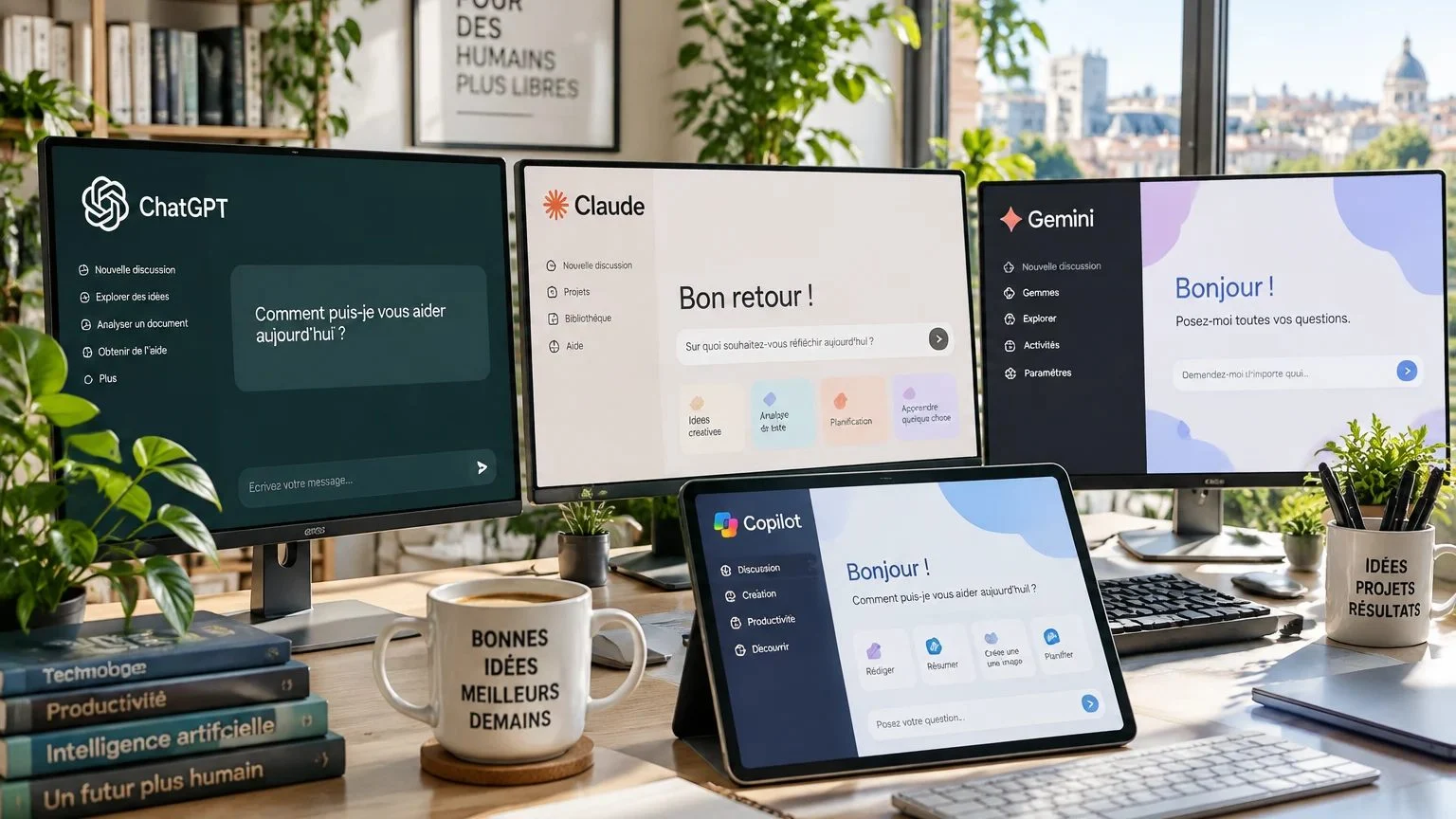
In just a few years, artificial intelligence assistants have gone from technological curiosity to everyday work tool. Writing, programming, information research, document analysis or image creation: the uses keep multiplying, and so do the offerings.
Faced with this abundance, one question often comes up: which AI should you choose? The answer largely depends on your needs. Each major player has developed its own identity, strengths and a few limitations. Here is an overview of the main models on the market and what sets them apart.
ChatGPT, the versatile mainstream option
Developed by OpenAI, ChatGPT is the assistant that brought generative AI to the general public. It remains the benchmark for many users today, thanks in particular to its simple interface and its rich set of features.
Its great strength is its versatility. ChatGPT can do almost everything well, and often very well:
- write, summarize and rephrase texts in many languages;
- generate images directly from the conversation;
- hold spoken conversations thanks to a natural voice mode;
- browse the web to provide up-to-date information;
- create custom assistants tailored to specific tasks.
Its highly developed ecosystem and large community make it a reassuring choice for getting started. On the other hand, this versatility means it is not always the best at highly specialized tasks, where some competitors may outperform it.
Claude, the benchmark for writing and code
Designed by Anthropic, Claude has established itself among professionals looking for nuanced, polished answers. The company places strong emphasis on the safety and reliability of its models, which shows in the assistant’s measured tone.
Claude is particularly appreciated for:
- the quality of its writing style, often considered more natural and less formulaic;
- its ability to analyze long documents in one go;
- its programming performance, highly valued by developers;
- its rigor in reasoning and in following complex instructions.
It is ideally suited to writers, lawyers, analysts and technical teams. Its main weakness lies in a less extensive ecosystem of additional features than ChatGPT’s, particularly for image generation, which it does not offer natively.
Gemini, the power of the Google ecosystem
With Gemini, Google is betting on an asset few competitors can match: deep integration with its own services. Gmail, Google Docs, Drive, Calendar and YouTube can all interact with the assistant, which considerably simplifies everyday work.
Gemini’s strengths are numerous:
- a natively multimodal approach, capable of handling text, images, audio and video;
- privileged access to Google Search for up-to-date information;
- seamless integration into Android and the Google Workspace office suite;
- the ability to work on very large volumes of content.
For users already rooted in the Google universe, Gemini is often the most natural choice. It is, however, less relevant for those who mainly work with other tools.
Mistral, Llama and DeepSeek: the open alternative
Alongside the closed American giants, another philosophy is gaining ground: that of models whose weights are published and can be downloaded, adapted and deployed freely according to their licenses.
Mistral AI, the European champion
French start-up Mistral AI offers both open models and a consumer assistant, Le Chat. Its strengths: excellent command of French, efficient and fast models, and a European sovereignty argument valued by companies and public administrations concerned about where their data is stored.
Llama, Meta’s open source bet
Meta distributes its Llama family of models openly. They have become a widely used foundation for developers and researchers who want to build their own solutions, run them on their own servers or specialize them for a specific domain.
DeepSeek, efficiency from China
DeepSeek surprised the industry by releasing open models with solid reasoning capabilities, particularly in mathematics and programming, while claiming great development efficiency. Some companies nevertheless remain cautious about data handling when using its online service.
Copilot and Grok: AI at the heart of platforms
Microsoft Copilot relies in particular on OpenAI’s technologies and stands out for its integration into Windows, Edge and the Microsoft 365 suite. For companies that live in Word, Excel, Outlook and Teams, it makes it possible to write, summarize meetings or analyze spreadsheets without leaving their usual tools.
Grok, developed by xAI, is closely tied to the social network X. Its distinctive feature: access to the platform’s posts, useful for following news and trends in real time, along with a deliberately more casual tone than its competitors.
How to choose the right AI for your needs
There is no single best AI in absolute terms, but rather a tool better suited to each situation. To help you find your way, here are a few simple guidelines:
- For versatile, mainstream use: ChatGPT.
- For polished writing, document analysis and code: Claude.
- For use integrated with Gmail, Docs and Android: Gemini.
- For working in Microsoft 365: Copilot.
- For European sovereignty and French: Mistral.
- For hosting and customizing your own model: Llama, Mistral or DeepSeek.
- For following social media news: Grok.
The most effective approach is often to test several assistants on your own tasks. Most offer a free version, which is enough to get a good idea. Also remember to check the data usage terms, especially in a professional context.
Finally, keep in mind that this market is evolving extremely fast. New versions follow one another and performance gaps narrow or reverse regularly. Rather than looking for a definitive winner, it is better to understand each player’s philosophy in order to choose, and reassess, the tool that best fits the way you work.